Switch Statements
What is a switch statement?
The switch statement is a decision-making statement in C that allows a program to select and execute one block of code from several alternatives based on the value of a single variable or of a simple expression (called the controlling expression). The value of this expression may be of type int or char, but not of type float or double.
For example, suppose a user enters a number from 1 to 3:
- If the number is 1, display One.
- If the number is 2, display Two.
- If the number is 3, display Three.
- Otherwise, display Invalid choice.
A switch statement is useful when we need to compare one expression against several fixed values.
Syntax of the switch statement
switch (expression)
{
    case constant1: statements;
			break;
    case constant2: statements;
			break;
    case constant3: statements;
			break;
    default: statements;
}
Note: constant can be ither numaric values or charecter values
How does a switch statement work?
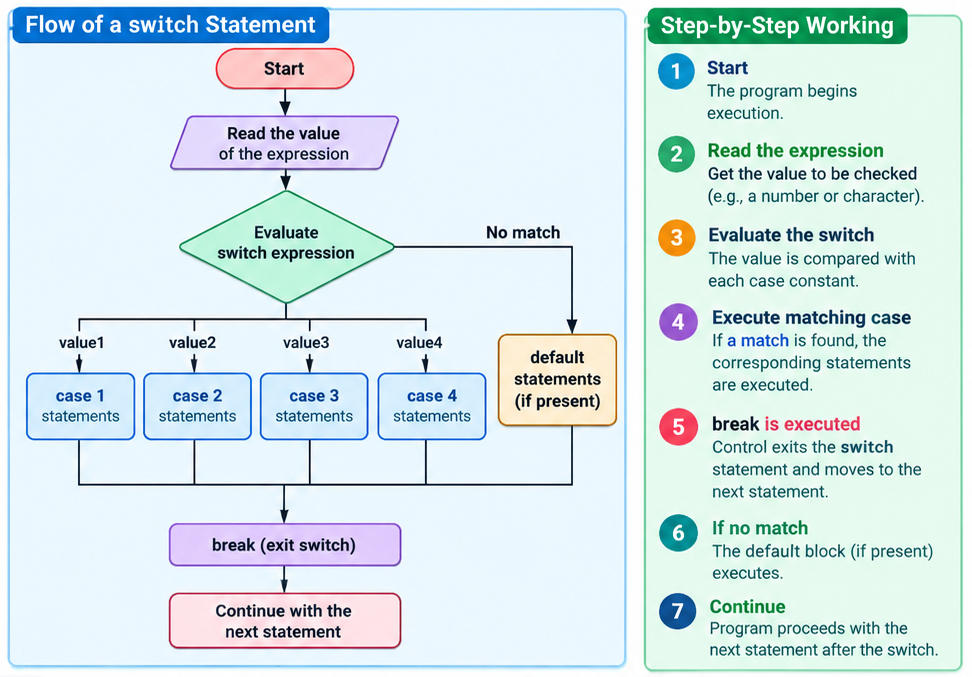
Example 1: C Program to display a day using switch
#include

int main(void)
{
    int day;

    printf("Enter a day number (1-7): ");
    scanf("%d", &day);

    switch (day)
    {
        case 1: printf("Monday");
            break;

        case 2: printf("Tuesday");
            break;

        case 3: printf("Wednesday");
            break;

        case 4: printf("Thursday");
            break;

        case 5: printf("Friday");
            break;

        case 6: printf("Saturday");
            break;

        case 7: printf("Sunday");
            break;

        default: printf("Invalid day number");
    }

    return 0;
}
Why is break important?
The break statement stops execution of the current switch statement and transfers control to the statement following it. Consider this program without break:
What is the purpose of default?
The default block executes when none of the case labels matches the value of the expression.
Output: Enter a day number (1-7): 10
		Invalid day number
C Program for Simple calculator using switch-case (arthmetic operations using switch)
#include

int main(void)
{
    double a, b;
    char op;

    printf("Enter an operator (+, -, *, /): ");
    scanf(" %c", &op);

    printf("Enter two numbers: ");
    scanf("%lf %lf", &a, &b);

    switch (op)
    {
        case '+': printf("Result = %.2f", a + b);
                  break;

        case '-': printf("Result = %.2f", a - b);
                  break;

        case '*': printf("Result = %.2f", a * b);
                  break;

        case '/': if (b != 0)
                     printf("Result = %.2f", a / b);
                  else
                     printf("Division by zero is not allowed");
                  break;

        default: printf("Invalid operator");
    }

    return 0;
}
Rules and limitations of switch-case
- case labels must be constant expressions that can be used as integer constant expressions.
- Duplicate case values are not allowed.
- The default label is optional.
- break exits the nearest enclosing switch or loop, not just the current case.
- Unlike an if condition, a case label cannot directly test a range such as case 1 to 5 in standard C.
- Strings and floating-point values cannot be used directly as switch expressions in standard C.
Difference between if-else and switch
| if-else | switch |
|---|---|
| Tests conditions or expressions. | Selects among matching constant case values. |
| Supports relational operators such as <, >, and <=. | Does not directly test relational ranges in case labels. |
| Can test complex logical conditions. | Commonly tests one expression against fixed values. |
| Suitable for ranges and complex decisions. | Suitable for menus and fixed choices. |
| Uses else as the final alternative. | Uses optional default as the unmatched alternative. |
Practice questions
- Define the switch statement and explain its syntax.
- Explain the purpose of case, break, and default.
- Write a C program to display the day of the week using switch.
- Write a C program to perform arithmetic operations using switch.
- Differentiate between if-else and switch-case.
- Explain the rules and limitations of a switch statement.