
Take an example subnet of hosts and obtain a broadcast tree for the subnet.
Implement Broadcast Tree
Input Graph:
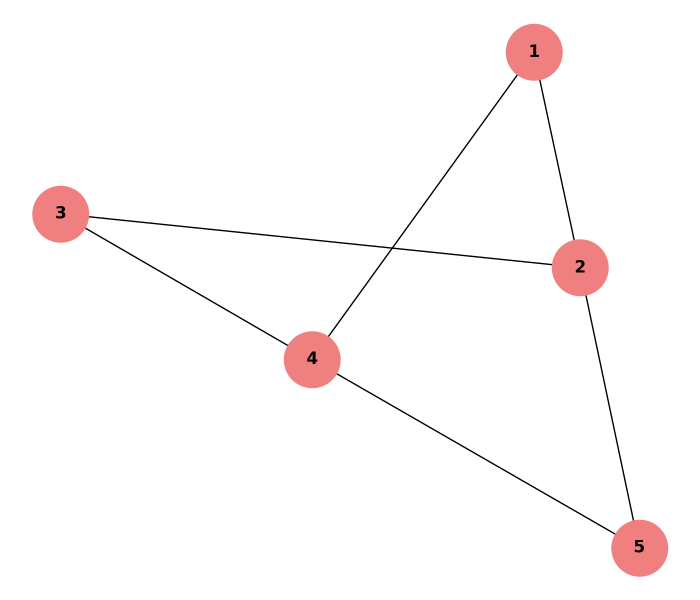
Source Code:
File Name: broadcast.c
#include<stdio.h>

#define MAX 10

int adjacencyMatrix[MAX][MAX];
int numNodes;

// Function to display adjacent nodes of a given node
void displayAdjacentNodes(int rootNode) {
    int i;

    printf("\nAdjacent nodes of node %d:\n", rootNode);

    for (i = 1; i <= numNodes; i++) {
        if (adjacencyMatrix[rootNode][i] == 1 || adjacencyMatrix[i][rootNode] == 1) {
            printf("%d\t", i);
        }
    }

    printf("\n");
}

int main() {
    int i, j, rootNode;

    // Input number of nodes
    printf("Enter number of nodes: ");
    scanf("%d", &numNodes);

    // Input the adjacency matrix
    printf("Enter adjacency matrix:\n");
    for (i = 1; i <= numNodes; i++) {
        for (j = 1; j <= numNodes; j++) {
            printf("Is there a connection from node %d to node %d (1=yes, 0=no): ", i, j);
            scanf("%d", &adjacencyMatrix[i][j]);
        }
    }

    // Input the root node
    printf("Enter root node (1 to %d): ", numNodes);
    scanf("%d", &rootNode);

    // Display adjacent nodes
    displayAdjacentNodes(rootNode);

    return 0;
}
Output:
$ gcc broadcast.c
$ ./a.out
Enter number of nodes: 5
Enter adjacency matrix:
Is there a connection from node 1 to node 1 (1=yes, 0=no): 0
Is there a connection from node 1 to node 2 (1=yes, 0=no): 1
Is there a connection from node 1 to node 3 (1=yes, 0=no): 0
Is there a connection from node 1 to node 4 (1=yes, 0=no): 1
Is there a connection from node 1 to node 5 (1=yes, 0=no): 0
Is there a connection from node 2 to node 1 (1=yes, 0=no): 1
Is there a connection from node 2 to node 2 (1=yes, 0=no): 0
Is there a connection from node 2 to node 3 (1=yes, 0=no): 1
Is there a connection from node 2 to node 4 (1=yes, 0=no): 0
Is there a connection from node 2 to node 5 (1=yes, 0=no): 1
Is there a connection from node 3 to node 1 (1=yes, 0=no): 0
Is there a connection from node 3 to node 2 (1=yes, 0=no): 1
Is there a connection from node 3 to node 3 (1=yes, 0=no): 0
Is there a connection from node 3 to node 4 (1=yes, 0=no): 1
Is there a connection from node 3 to node 5 (1=yes, 0=no): 0
Is there a connection from node 4 to node 1 (1=yes, 0=no): 1
Is there a connection from node 4 to node 2 (1=yes, 0=no): 0
Is there a connection from node 4 to node 3 (1=yes, 0=no): 1
Is there a connection from node 4 to node 4 (1=yes, 0=no): 0
Is there a connection from node 4 to node 5 (1=yes, 0=no): 1
Is there a connection from node 5 to node 1 (1=yes, 0=no): 0
Is there a connection from node 5 to node 2 (1=yes, 0=no): 1
Is there a connection from node 5 to node 3 (1=yes, 0=no): 0
Is there a connection from node 5 to node 4 (1=yes, 0=no): 1
Is there a connection from node 5 to node 5 (1=yes, 0=no): 0
Enter root node (1 to 5): 4

Adjacent nodes of node 4:
1       3       5
💻 Run This C Program
Take an example subnet of hosts and obtain a broadcast tree for the subnet.
The selected C program is loaded
automatically into the editor.
Edit the program, provide input through
STDIN if required
and click Run.
The compiler is embedded using OneCompiler.
Your C program runs inside the embedded
C environment; Study Glance does not execute
C code directly on your web server.
Enter the input values of the program in the
STDIN box before clicking Run.