
Write a Program to implement Breadth First Search (BFS) using Python.
Input Graph
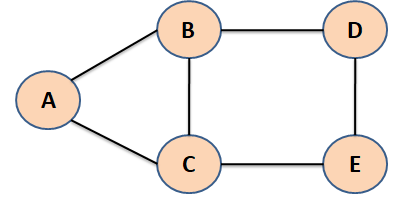
SOURCE CODE :
 # Input Graph
graph = {
'A' : ['B','C'],
'B' : ['A','C','D'],
'C' : ['A','B','E'],
'D' : ['B','E'],
'E' : ['C','D']
}
# To store visited nodes.
visitedNodes = []
# To store nodes in queue
queueNodes = []
# function
def bfs(visitedNodes, graph, snode):
	visitedNodes.append(snode)
	queueNodes.append(snode)
	print()
	print("RESULT :")
	while queueNodes:
		s = queueNodes.pop(0)
		print (s, end = " ")
		for neighbour in graph[s]:
			if neighbour not in visitedNodes:
				visitedNodes.append(neighbour)
				queueNodes.append(neighbour)

# Main Code
snode = input("Enter Starting Node(A, B, C, D, or E) :").upper()
# calling bfs function
bfs(visitedNodes, graph, snode)
OUTPUT :
Sample Output 1:
-------------------
Enter Starting Node(A, B, C, D, or E) :A

RESULT :
A B C D E
------------------------------------------------------------------
Sample Output 2:
-------------------
Enter Starting Node(A, B, C, D, or E) :B

RESULT :
B A C D E
💻 Run This Python Program
Write a Program to implement Breadth First Search (BFS) using Python.
The selected Python program is loaded
automatically into the editor.
Edit the program, provide input if required
and click Run.
The compiler is embedded using OneCompiler.
Your Python program runs inside the embedded
Python environment; Study Glance does not execute
Python code directly on your web server.
If the program asks for input (for example the
starting node), type the value in the
STDIN box before clicking Run.