
A Fibonacci sequence is defined as follows: the first and second terms in the sequence are 0 and 1. Subsequent terms are found by adding the preceding two terms in the sequence. Write a C program to generate the first n terms of the sequence.
A Fibonacci sequence is defined as follows: the first and second terms in the sequence are 0 and 1. Subsequent terms are found by adding the preceding two terms in the sequence. Write a C program to generate the first n terms of the sequence.
Algorithm
start
	step1: a := 0, b:= 1
	step2: Read n
	step3: Print "Fibonacci sequence" a,b
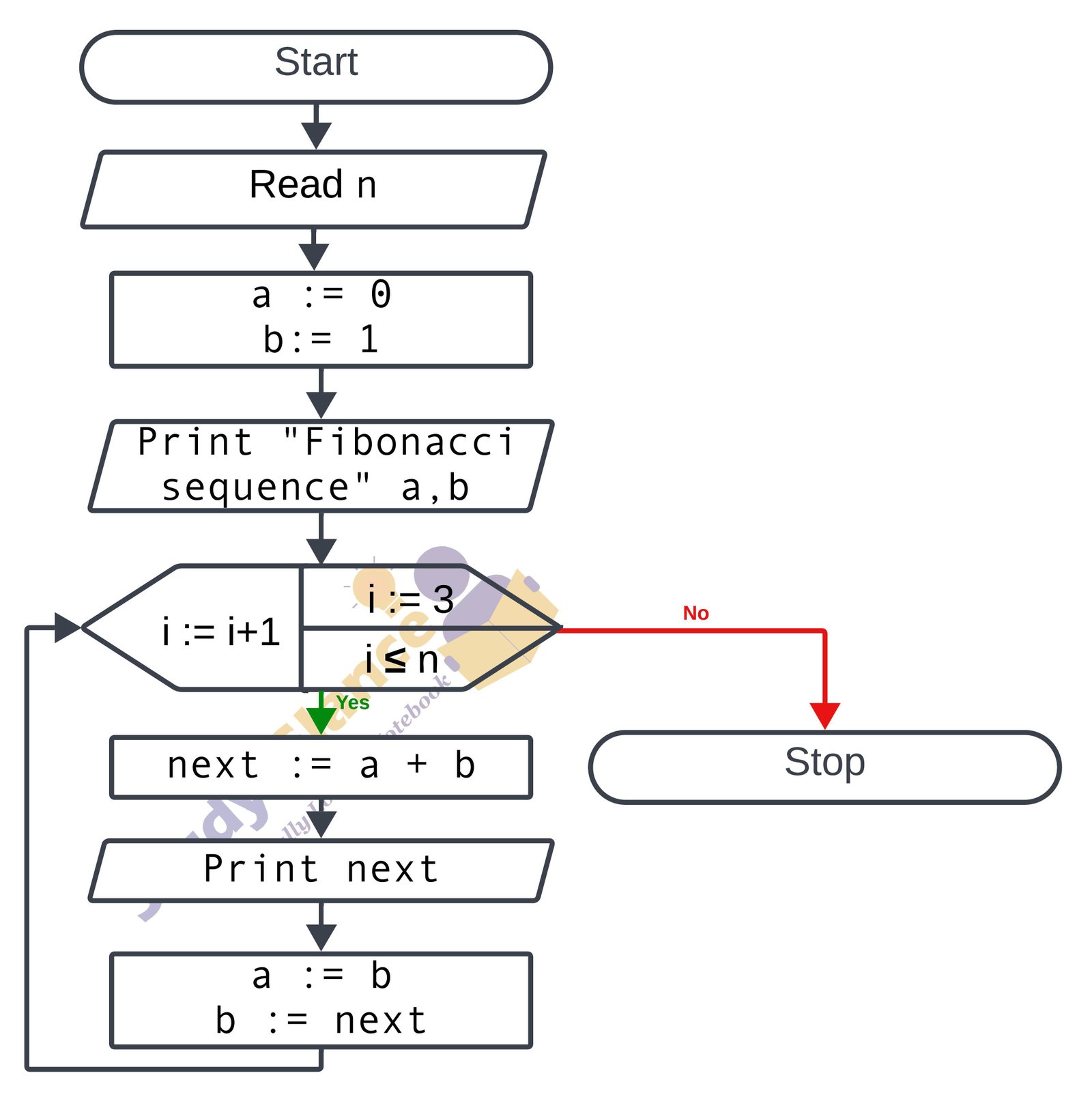
	step4: for i := 3 to n step 1 do
	step5: 	next := a + b
	step6: 	Print next
	step7: 	a := b
	step8: 	b := next
stop
Flowchart
C Programming
//to generate the first n terms of the Fibonacci sequence
#include <stdio.h>

int main() {
    int n, a = 0, b = 1, next,i;

    printf("Enter the number of terms you want in the Fibonacci sequence: ");
    scanf("%d", &n);
    printf("Fibonacci Sequence:\n");
    printf("%d %d ",a,b);
    for (i = 3; i <= n; i++) {
        next = a + b;
        printf("%d ", next);
        a = b;
        b = next;
    }
    return 0;
}
OUTPUT
Enter the number of terms you want in the Fibonacci sequence: 9
Fibonacci Sequence:
0 1 1 2 3 5 8 13 21
💻 Run This C Program
A Fibonacci sequence is defined as follows: the first and second terms in the sequence are 0 and 1. Subsequent terms are found by adding the preceding two terms in the sequence. Write a C program to generate the first n terms of the sequence.
The selected C program is loaded automatically. Edit the code,
provide input through STDIN and click Run.
The compiler is embedded using OneCompiler. Your program runs in
the embedded C environment; Study Glance does not execute C code
directly on your web server.