Introduction
Introduction to Scripting Languages
A scripting language is a type of programming language in which the instructions are interpreted individually at runtime.
In other words, scripting languages are specialized programming languages used for website development, data processing, system administration and automation of tasks.
(or)
A scripting language is a programming language that is used to write small programs called scripts. These scripts are generally used to automate tasks, control software applications and develop dynamic websites.
Traditional programming languages generally require a compilation step before execution, whereas scripting languages are typically executed directly by an interpreter without requiring a separate compilation step.
However, scripting languages are actually a subset of programming languages. All scripting languages are programming languages, but not all programming languages are scripting languages.
What is a Script?
A script is a set of instructions written in a scripting language to perform a specific task.
For example, the following Python script displays a welcome message.
Script:print ("Hello Study Glance!");
print ("Welcome to Scripting Languages");Hello Study Glance!
Welcome to Scripting LanguagesTypes of Scripting Languages
Scripting languages are classified into two types based on where the scripts are executed and what tasks they perform. Those are,
- Client-Side Scripting Languages
- Server-Side Scripting Languages
1. Client-Side Scripting Languages
A client-side scripting language is a scripting language in which the script is executed on the user's computer or device, usually inside a web browser.
These scripts are generally used to make web pages interactive, validate user input, perform calculations and respond to user actions without requiring server interaction.
Examples: JavaScript, TypeScript, Dart
2. Server-Side Scripting Languages
A server-side scripting language is a scripting language in which the script is executed on a web server rather than on the user's web browser.
Server-side scripts are mainly used to process user requests, communicate with databases, perform authentication, manage sessions and generate dynamic web pages.
Examples: PHP, Python, Ruby, Perl, Tcl, JavaScript (Node.js)
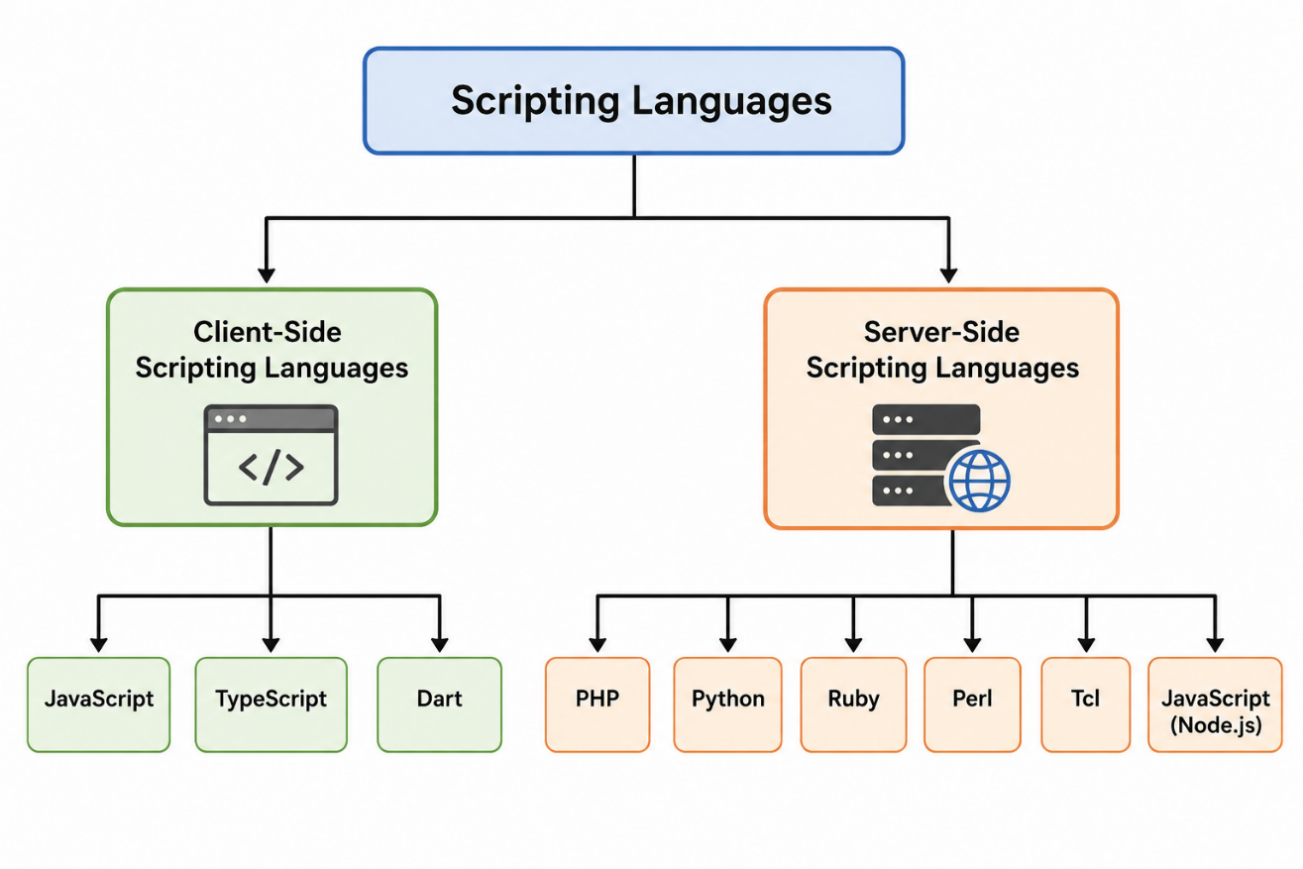 Fig: Classification of Scripting Languages
Applications of Scripting Languages
Scripting languages are widely used in various fields to develop applications. Some important applications are,
- Web Development
- Software Testing
- Task automation
- Data Processing / Data analysis
- System Administration
- Game development