Mining Various kinds of Association Rules
An association rule is a statement of the form "If A, then B," where A and B are sets of items. The strength of an association rule is measured using two measures: support and confidence. Support measures the frequency of the occurrence of the items in the rule, and confidence measures the reliability of the rule.
There are various types of association rules in data mining:
- Multi-level association rules
- Multidimensional association rules
- Quantitative association rules
Multi-level association rules
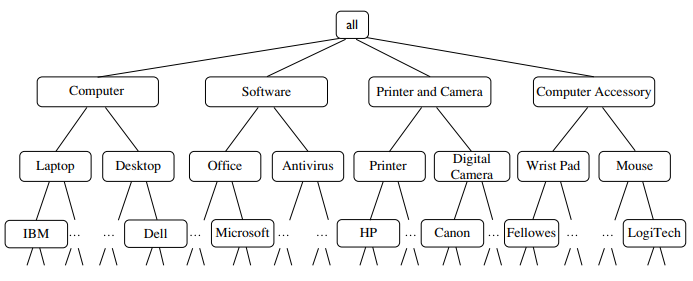
Association rules generated from mining data at multiple levels of abstraction are called multiple-level or multilevel association rules. Multilevel association rules can be mined efficiently using concept hierarchies under a support-confidence framework.
Multilevel Association Rule mining is a technique that extends Association Rule mining to discover relationships between items at different levels of granularity.
For example, in a retail dataset, multi-level Association Rule mining can be used to find relationships between individual items and categories of items.
Multidimensional association rules
Single dimensional (intra dimensional) association rules
Association rules that involve a single dimension or predicate can be referred to as single dimensional or intra dimensional association rules.
Example:
buys (X, "Computer") ⇒ buys (X, "Printer")
The above rule is a single dimensional or intra dimensional association rule because it contains a single distinct predicate (e.g., buys) with multiple occurrences (i.e., the predicate occurs more than once within the rule).
Multidimensional association rules
Association rules that involve two or more dimensions or predicates can be referred to as multidimensional association rules.
Example:
age (X, "20...29") ∧ occupation (X, "student") ⇒ buys (X, "laptop")
The above rule contains three predicates (age, occupation, and buys), each of which occurs only once in the rule.
Inter dimensional association rules
Multidimensional association rules with no repeated predicates are called inter dimensional association rules. The above rule is an example of an inter dimensional association rule.
Hybrid-dimensional association rules
Multidimensional association rules with repeated predicates, which contain multiple occurrences of some predicates, are called hybrid-dimensional association rules.
Example:
age (X, "20...29") ∧ buys (X, "laptop") ⇒ buys (X, "printer")
Quantitative association rules
Quantitative association rules are multidimensional association rules in which the numeric attributes are dynamically determined during the mining process so as to satisfy some mining criteria, such as maximizing the confidence or compactness of the rules mined.
Quantitative association rules can have two quantitative attributes on the left-hand side of the rule and one categorical attribute on the right-hand side of the rule. That is,
Aquant1 ∧ Aquant2 ⇒ Acateg
where Aquant1 and Aquant2 are tests on quantitative attribute intervals (where the intervals are dynamically determined), and Acateg tests a categorical attribute from the task-relevant data.
For instance, suppose you are curious about the association relationship between pairs of quantitative attributes, like customer age and income, and the type of television (such as high-definition TV, i.e., HDTV) that customers like to buy. An example of such a 2-D quantitative association rule is
age (X, "30...39") ∧ income (X, "42K...48K") ⇒ buys (X, "HDTV")