Rule–based classification
Rule-based classification in data mining is a technique in which the records are classified / categorized by using a set of “IF…THEN…” rules.
Rules are a good way of representing information or bits of knowledge. A rule-based classifier uses a set of IF-THEN rules for classification.
An IF-THEN rule is an expression of the form
IF condition THEN conclusion.
An example is rule R1,
R1: IF age = youth AND student = yes THEN buys_computer = yes.
The “IF” part (or left side) of a rule is known as the rule antecedent or precondition. The “THEN” part (or right side) is the rule consequent.
In the rule antecedent, the condition consists of one or more attribute tests (e.g., age = youth and student = yes) that are logically ANDed. The rule’s consequent contains a class prediction (in this case, we are predicting whether a customer will buy a computer). R1 can also be written as
R1: (age = youth) ^ (student = yes) => (buys computer = yes)
If the condition (i.e., all the attribute tests) in a rule antecedent holds true for a given tuple, we say that the rule antecedent is satisfied (or simply, that the rule is satisfied) and that the rule covers the tuple.
A rule R can be assessed by its coverage and accuracy.
Coverage: A rule’s coverage is the percentage of tuples that are covered by the rule.
Accuracy: A rule’s accuracy is the percentage of tuples that are correctly classified by the rule.
Given a tuple, X, from a class labelled data set, D, let ncovers be the number of tuples covered by R; ncorrect be the number of tuples correctly classified by R; and |D| be the number of tuples in D. We can define the coverage and accuracy of rule R as
Example: Rule accuracy and coverage. Let’s go back to our data set in Table-1. These are class labelled tuples from the customer database. Our task is to predict whether a customer will buy a computer.
Consider rule R1, which covers 2 of the 14 tuples. It can correctly classify both tuples. Therefore, coverage R1 (D) = 2/14 = 14.28% and accuracy R1 (D) = 2/2 = 100%.
Rule Extraction from a Decision Tree
Decision tree classifiers are a popular method of classification - it is easy to understand how decision trees work and they are known for their accuracy. Decision trees can become large and difficult to interpret.
In this, we look at how to build a rule-based classifier by extracting IF-THEN rules from a decision tree. In comparison with a decision tree, the IF-THEN rules may be easier for humans to understand, particularly if the decision tree is very large.
To extract rules from a decision tree, one rule is created for each path from the root to a leaf node. Each splitting criterion along a given path is logically ANDed to form the rule antecedent (“IF” part). The leaf node holds the class prediction, forming the rule consequent (“THEN” part).
Example: Extracting classification rules from the following decision tree.
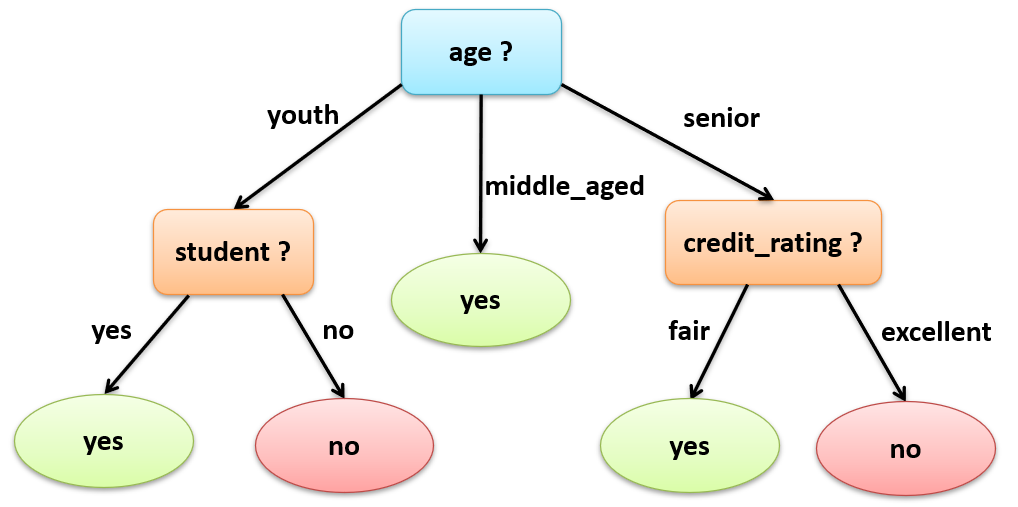
The decision tree of the above Figure can be converted to classification IF-THEN rules by tracing the path from the root node to each leaf node in the tree.
The rules extracted from the above Figure are as follows:
R1: IF age = youth AND student = yes THEN buys_computer = yes
R2: IF age = youth AND student = no THEN buys_computer = no
R3: IF age = middle_aged THEN buys_computer = yes
R4: IF age = senior AND credit_rating = excellent THEN buys_computer = yes
R5: IF age = senior AND credit_rating = fair THEN buys_computer = no