Constraint based Association mining
A data mining process may uncover thousands of rules from a given set of data, most of which end up being unrelated or uninteresting to the users.
Often, users have a good sense of which “direction” of mining may lead to interesting patterns and the “form” of the patterns or rules they would like to find.
Thus, a good heuristic is to have the users specify such intuition or expectations as constraints to confine the search space. This strategy is known as constraint-based mining.
Constraint-based algorithms need constraints to decrease the search area in the frequent itemset generation step. The general constraint is the minimum support threshold.
The constraints can include the following:
- Knowledge type constraints: These constraints specify the type of knowledge to be mined, such as association or correlation.
- Data constraints: These constraints specify the set of task-relevant data.
- Dimension/attribute constraints: These constraints specify the desired dimensions (or attributes) of the data, to be used in mining.
- Interestingness constraints: These constraints specify thresholds on statistical measures of rule interestingness, such as support, confidence, and lift.
- Rule constraints: These constraints specify the form of rules to be mined. Such constraints may be expressed as metarule (rule templates), as the maximum or minimum number of predicates that can occur in the rule antecedent or consequent, or as relationships among attributes, attribute values, and/or aggregates.
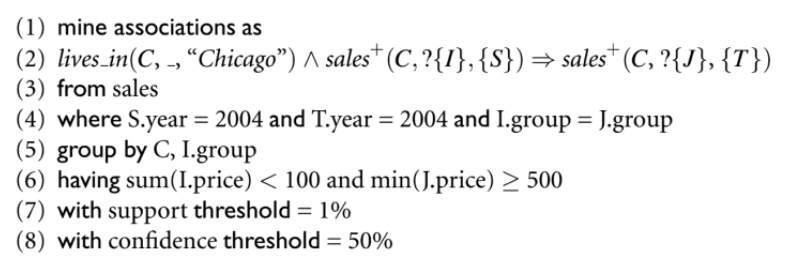
For Example, Our association mining query is to “Find the sales of which cheap items (where the sum of the prices is less than $100) may promote the sales of which expensive items (where the minimum price is $500) of the same group for Chicago customers in 2004.” This can be expressed in the DMQL data mining query language as follows,